


SARASOTA’S CAR HISTORY – MUSEUMS, ROADS, AND THE HISTORY OF TRANSITION IN SARASOTA FLORIDA.
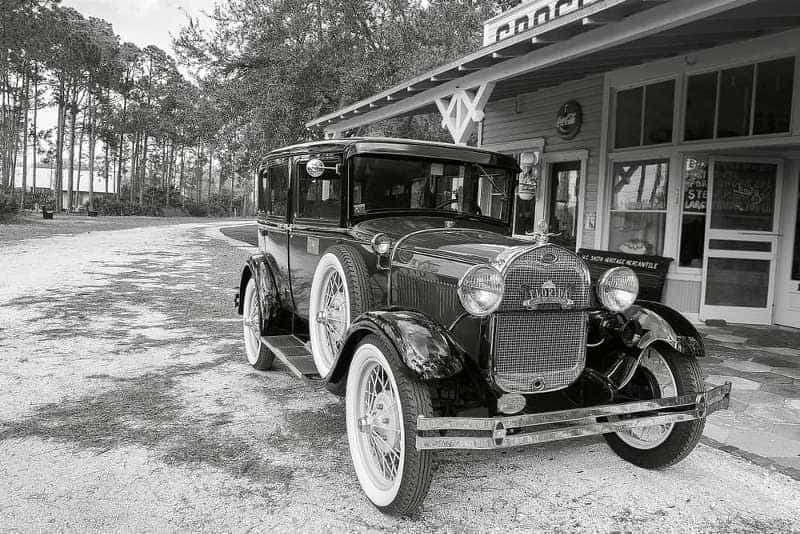
It is impossible to accurately recount the history of Sarasota without acknowledging the role the automobile played in fueling the state’s spectacular growth and development. Indeed, Florida’s evolution from a sweltering, mosquito-infested backwater into the nation’s third most populous state almost always includes harrowing tales about how men battled the harshest of elements in order to build roads, highways, and bridges across some of the least forgiving landscapes in America. For without these vital pieces of infrastructure to accommodate the ever-growing number of automobiles headed for Florida, there could be no further development in the Sunshine State. (Of course, the same thing could be said about mosquito repellent. But that’s another story.)
The so-called “horseless carriage” began to appear in Florida in the 1890s, but the machines popularly referred to as “automobiles” didn’t show up until around 1900. Eduardo Manrara, a Tampa cigar manufacturer, purchased that city’s first automobile, which (ironically) used gasoline to generate steam which then propelled the car forward. He drove it up Florida Avenue for the first time on July 15, 1901. Thereafter, when people saw him motoring through the streets of Ybor City they could be overheard shouting, “the devil wagon is here!” No one could fathom why a man of such serious and sober demeanor would ride around town in such a strange and ridiculous contraption.
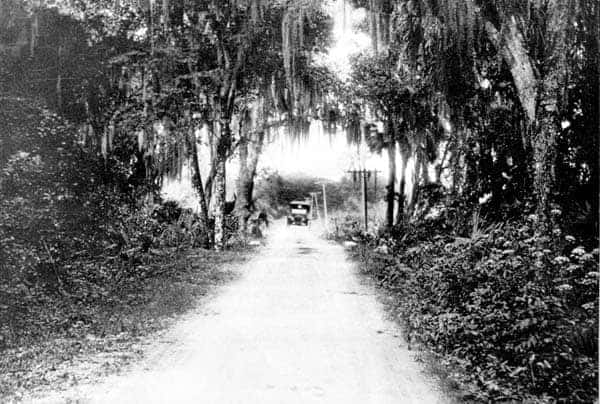
Gainesville’s first automobile showed up in 1905, and the first one to pass through Fort Pierce was in 1907 on its way from Jacksonville to Miami. That same year, Dr. C.B. Wilson, a prominent Sarasota physician, brought the first automobile to Sarasota. And since he built an addition onto his home to protect his fancy new 20-horsepowered REO Roadster, one presumes he is also responsible for Sarasota’s first garage.
Meanwhile Ford’s popular Model T—first introduced in 1908—was simple, sturdy, and somewhat more affordable compared with the other automobiles of the day. But it wasn’t inexpensive enough to satisfy Henry Ford, who was hell-bent on building a motor car that would appeal to the masses. “When I’m through,” he is reported to have said, “almost everybody will have one.”
Ford backed up those words in late 1913 when he launched his company’s first moving assembly line designed specifically to mass produce entire automobiles. While this was by no means the first assembly line to ever produce a car, it was certainly the most efficient, reducing the time it took to build a car from more than 12 hours to less than two. Suddenly the days of horseback as the principal means of personal transportation were seriously numbered.
In 1914, Ford added a mechanized belt to his assembly line that crept along at about six feet per minute. As that accelerated pace, the line produced more and more cars, and on June 4, 1924, the ten-millionth Model-T rolled off the assembly line at Ford’s Highland Park plant.
Naturally, more and more automobiles created the need for more and more roads. The opening of new highways in the 1920’s, especially those leading to the new American paradise of Florida, ushered in the era known as Tin Can Tourism, during which enterprising motorists jerry-rigged their cars to make them function like crude campers. Unfortunately, the roads they were required to travel on were every bit as crude. Few were paved and many were little more than ruts along which the cars ground and scraped their way.
One road however, the Tamiami Trail, is largely responsible for the growth and development of Sarasota and all of Southwest Florida’s Gulf Coast. Its 275-mile length—beginning at State Road 60 in Tampa and ending at US Rte. 1 in Miami, opened the Gulf Coast region to tourism as never before, thus paving the way for Southwest Florida to become the booming metroplex it is today.
The east-west section of the Tamiami Trail—which cuts across the Everglades linking Miami with Naples—took over 12 years and 2.6 million sticks of dynamite to complete. It cost the then staggering sum of $8 million which, adjusted for inflation, would equal about $120 million in today’s economy.
The massive expense seemed entirely justified, however, since the trip from Naples to Miami before such a highway was proposed required travelers to drive north to Tampa, cross over to Daytona, and then drive south to Miami. Even by today’s standards that would be quite a long haul. But back then it took more than a week and you weren’t speeding along a four-lane divided highway in your plush, air-conditioned Land Rover! It was the trip from hell (if you’ll pardon the expression) that had more in common with a wild west wagon train.
Building “The Trail” at any price was no easy feat, as Mother Nature, local politicians, and wealthy landowners with a personal stake in where the highway would go, threw down roadblocks all along the way. Indeed, had some people gotten their way, the trail would have travelled straight up the center of the state rather than along the coast. Dubbed the “Dixie Route,” it would have passed through such small Central Florida hamlets as LaBelle and Ft. Meade, while completely by-passing the coastal cities it now serves, including Sarasota and Bradenton.
Not to be outdone by a few politicians, Mother Nature threw in 75 miles of the swampy, alligator-infested Everglades that had to be tamed and paved over to complete the new road.
Thankfully, proponents of the coastal route prevailed and nearly 100 years later, the Gulf Coast cities that lie along its path—including Naples, Ft. Myers, Sarasota, and Bradenton—are booming as never before. Undoubtedly, much of their prosperity is due to the ease of accessibility that came with the completion of the Trail.
It seems entirely appropriate that the Tamiami Trail of today (aka, U.S. Rte.41) should pass right between the John & Mable Ringling Museum of Art and the Sarasota Classic Car Museum as it winds through North Sarasota. For had it not been for Ringling, along with the simultaneous rise of America’s automobile culture, there’s no telling what the Sarasota-Manatee region would look like today. Happily, we will never find out. But a visit to each of these museums will show you just how much their namesakes impacted the future growth and development of today’s Sarasota.
0 comment(s) so far on SARASOTA’S CAR HISTORY – MUSEUMS, ROADS, AND THE HISTORY OF TRANSITION IN SARASOTA FLORIDA.